
01 of 04
Strategy
Defining where the business grows, which markets and offers it focuses on, and translating that into an executable plan with clear priorities.
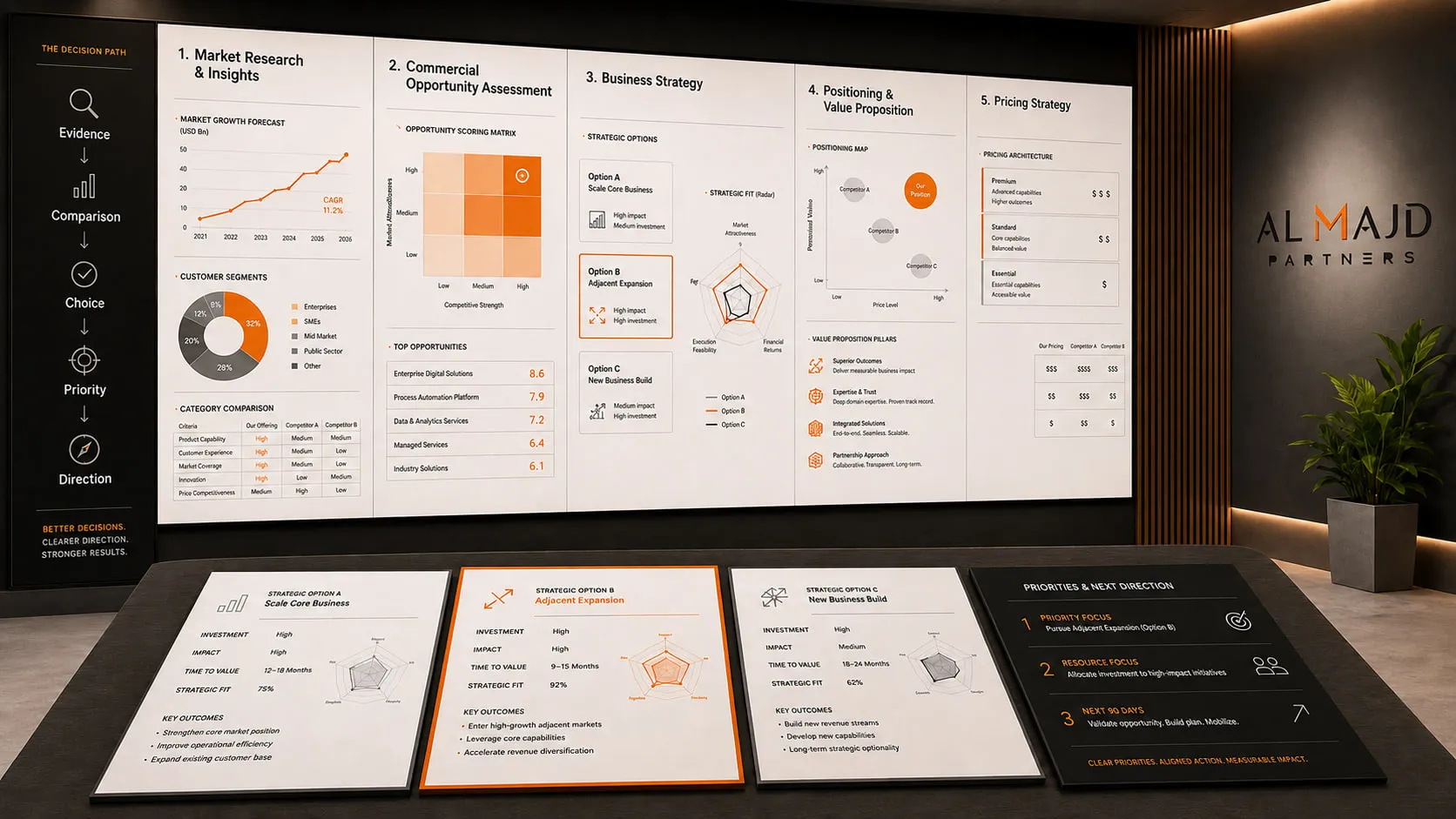
We build the evidence base, assess the opportunity, and determine where the business grows, with which offer and at what price — then translate that into an executable roadmap.
When does your business need this service?
- Assessing a market, sector, service or opportunity before committing to it.
- Multiple management priorities, with no clear basis for choosing between them.
- A strong offer, but positioning or differentiation that is not clear to the market.
- Pricing that reflects neither the value of the offer nor market conditions.
- Decisions built on assumptions rather than current evidence.
Scope of work
Market research and commercial insight
The evidence base on which the decisions that follow are built — from market size and customer behaviour to competitor moves and underserved opportunities.
- Market size, trends and what drives them
- Customer behaviour, purchase drivers and selection criteria
- Competitor analysis and offer comparison
- Segments and underserved gaps
- Insight written to serve the decision, not to present data
Opportunity assessment and commercial feasibility
Judging a specific opportunity before allocating resources to it — whether it is worth pursuing, on what terms, and what getting it wrong would cost.
- Opportunity attractiveness and realistic size
- Demand and commercial potential
- Requirements, risks and assumption sensitivity
- Preliminary commercial feasibility
- A clear recommendation: proceed, adjust or stop
Growth strategy and expansion options
Determining where the business grows and why — which markets, sectors, segments and growth paths deserve the concentration of resources, and which do not.
- Priority markets, sectors and segments
- Growth paths: deepening, expansion, adjacencies, new markets
- Organic growth against growth through partners
- Trade-offs and resource concentration between options
- Growth scenarios and the conditions each depends on
Business model and service portfolio
Determining what the business actually sells, how it captures value from it, and what should be added, combined or discontinued.
- Review of the service or product portfolio
- Revenue model and how value is captured
- Offer structure and service packaging
- Decisions to add, combine or discontinue
- Fit between the model, the business's capabilities and market conditions
Positioning and value proposition
Determining the position the business holds in the customer's mind, and the reason they choose it over the alternatives.
- Market and competitive positioning
- Value proposition for each target segment
- Genuine differentiation, not claimed differentiation
- The basis for messaging and the commercial argument
- Consistency between what is said and what is delivered
Pricing strategy and commercial model
Turning the value the business provides into a price and commercial structure that holds up against the market, competitors and negotiation.
- Pricing objectives and floors
- The value of the offer from the customer's perspective
- Competitive context and price sensitivity
- Pricing structure, packages and commercial terms
- Application guidance and exception management
Strategic roadmap and execution priorities
Translating strategic choices into a practical sequence — what is executed first, what is deferred, and how progress is measured.
- Sequencing and timing of initiatives
- Capabilities and resources each phase requires
- Performance indicators and review points
- Connecting strategy to go-to-market, marketing and business development
- Execution governance and follow-through
What you receive
- A market, customer and competitor report with conclusions written for the decision
- Competitive analysis and benchmarking against defined criteria
- Opportunity assessment with a clear recommendation: proceed, adjust or stop
- Growth options with trade-offs made explicit, and the conditions each depends on
- Portfolio review with decisions to add, combine or discontinue
- Positioning and value proposition framework for each target segment
- Pricing structure, commercial terms and application guidance
- Strategic roadmap with priorities, sequencing and indicators
Frequently asked questions
How long does strategy work usually take?
It depends on scope. Assessing a specific opportunity may take weeks, while a full strategic review extends over months. We set the timeline once the decision at hand is clear.
Do you execute the strategy, or stop at the recommendation?
Both, depending on what the work requires. Our services are connected, so moving from decision to execution does not mean handing the work to someone else.
Is strategy work suitable for small and mid-sized businesses?
Yes. The size of the decision is the criterion, not the size of the business. Entering a new market or changing pricing is a significant decision at any scale.
What if the opportunity is not viable?
We say so directly. A recommendation to stop is a legitimate outcome, and can matter more than a recommendation to proceed.
Related services
Go-to-Market — to translate the strategic decision into a practical route to market.
Marketing — to turn positioning into brand, content and demand.
Business Development — to carry strategic choices through to specific accounts and opportunities.